


Pro-choicers tend to predicate the abortion discussion on what is ultimately conjecture about available resources for mothers and their children. As the narrative goes, the mother exists in a dreadful world that is unsupportive and not at all conducive to her well-being. If abortion has anything to do with justice, it must be in the related injustice nature has subjected her to; all other considerations ought to be deferred until these matters are adequately addressed. In other words, unless external support is made available, abortion must be accessible. This view insufficiently addresses the core of the abortion issue, primarily in how it doesn’t account for the intentional killing of the child in the womb. But the purpose here is not to indulge in this egregious argumentative failure, but to discuss the support that exists today and some related misconceptions.
A few months ago, I participated in a panel discussion for donors at a pregnancy resource center in Georgia.1 Before the main event, I toured the facility. There were rooms organized for discussions, a medical room suitable for ultrasounds, and spaces with a welcoming sensibility. The site was stocked with an abundance of diapers, formula, clothes, and other goods. I suspect many would find all of this mundane, the expected qualities of one of the many charitable organizations doing good deeds, but it represents much more once you understand the current abortion debate.
One of the most common half-baked critiques of pro-lifers is that we “do not care about the baby once she is born.” Pro-life apologists often brush over these sentiments, typically because they are found embedded in poor arguments, but the genuine goal of caring for newborns is righteous—it is also one of the main objectives of pregnancy resource centers.
The Charlotte Lozier Institute (CLI) released its 2025 National Pregnancy Center Report which highlighted that 2,775 pregnancy centers nationwide provided over $452 million in total medical care, support and education services, and material goods in 2024. The fourth installment of CLI’s Legacy of Life & Love Series, this report demonstrates that pregnancy centers are serving women, men and families with unwavering care post-Dobbs and seeing continuous growth since CLI’s first national report in 2017.2
To better grasp the work that pregnancy resource centers do, it helps to compare them to Planned Parenthood. Both institutions are a sort of representation of each political position in the popular imagination, with pregnancy resource centers largely supported by pro-lifers and Planned Parenthood overwhelmingly supported by pro-choicers. It is also important to note that while Planned Parenthood is a national organization, pregnancy resource centers are localized, distinct entities.
There are around 600 Planned Parenthood sites in the United States, fewer than one-quarter the number of pregnancy resource centers nationwide.3 Some of Planned Parenthood’s top services include STI tests, pregnancy tests, reversible contraception, and abortion.4 Generally, the top services for pregnancy resource centers are free and include diapers, baby clothes, consultations, and pregnancy testing.5 While pregnancy resource centers don’t offer abortions, Planned Parenthood executed 402,200 abortions over the course of one year.6
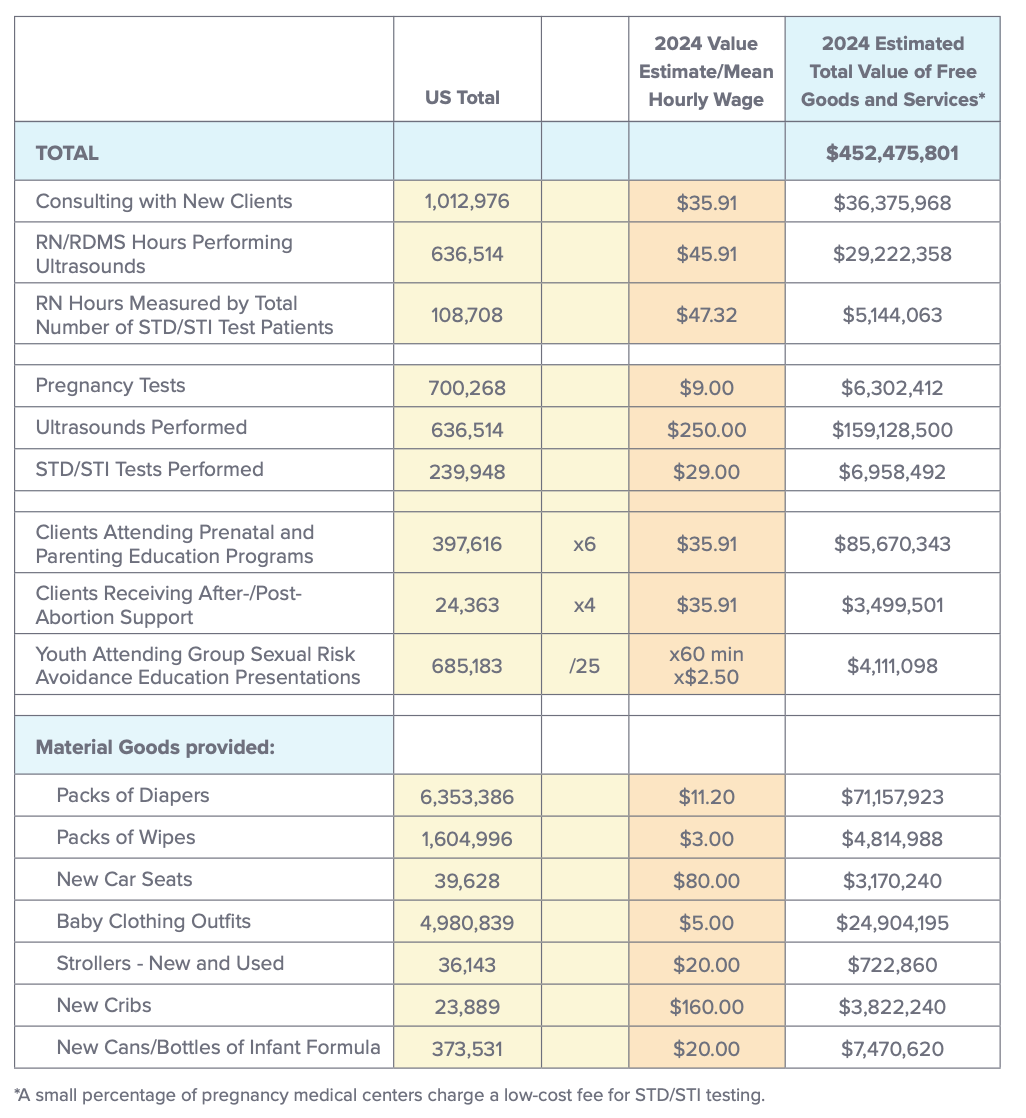
The table above provides a breakdown of the value of services and materials provided to clients of pregnancy resource centers in the United States.7
Pregnancy resource centers are not perfect. They are also not designed to replace the entirety of a mother’s natural obligation to her child, but to make it more manageable. Suffice to say, there is an expansive support apparatus available to assist mothers during and after pregnancy among local pregnancy resource centers across the country. And the mere existence of these sites demonstrates that pro-lifers do care for the baby once she is born.
That said, resources are not always enough, as the hypothetical pro-choice remark implies. For the mother to be served, she must adopt the appropriate posture. It may sound trivial, but no matter how many resources are available, she will still have to willfully engage with the organization to receive them. Picking up baby formula or new baby clothes requires physically driving to the facility and following the site’s process. She may have family issues going on—as many mothers who consider or who have considered abortion do—and could benefit from targeted guidance. This would again require concrete action on her part. The resources and support infrastructure are meaningless unless mothers are willing to participate.
As discussed at the center I visited, some women are made aware of the support available but still deny service, sometimes due to external pressures. Others will cancel appointments because they have already procured an abortion. Pro-choicers wield the notion of support, as if such a system can be expected to solve the abortion issue, but in reality, we already have a stable charitable network in place. Yet, mothers still decide to walk away, leaving an abundance of resources on the table, as it were.
Pregnancy-related resources target different forms of poverty of the mother. There is the material category, which is generally the easiest to mend. It’s the basics, like formula and clothes. Then there is immaterial support, which, in essence, targets the spirit of the women; guidance and education are fitting to consider here. Mothers who willingly reject assistance and instead choose abortion are poor in spirit. Her deficiency is found deep within her soul, which might follow from ignorance or a severely misaligned will. There’s a tendency to suggest that simply better external conditions would alleviate or eliminate abortion, but even an unlimited amount of resources could not guarantee change within such a person.
“For you always have the poor with you, but you will not always have me.”(Matthew 26:11)
We will never completely eliminate poverty. Because we have those poor in character, when you make a vicious act like abortion easily accessible—especially when you paint it as a virtue—mothers will choose it. Here, one can better see the importance of pursuing not only charitable community initiatives, as discussed presently, but also political change aimed at circumventing grave evils. Unfortunately, even in better societal circumstances, abortions will still happen, albeit in much smaller numbers.
However, we don’t pursue justice and charity because they are guaranteed to bring about a desired positive outcome, but because they are goods in themselves. When we align our person in such a way, we begin to understand the rationality of our cause. This seemed implicit in the work and motivations of the staff I met in Georgia. They care about the pro-life position, but their work transcends any sort of preoccupation with political goals. Consistently, they serve the most vulnerable, and although some will turn away from an extended hand, the mission continues without hindrance; their focus is on doing good and avoiding evil. A beautiful approach that, interestingly enough, is incompatible with abortion.
Weigel, James. “On My Recent Trip to Georgia: Panel Discussion, Campus Engagement, and Visiting a Pregnancy Resource Center.” November 13, 2025. https://www.thejamesweigel.com/p/on-my-recent-trip-to-georgia?r=46hrm8.
Charlotte Lozier Institute. “New: Pregnancy Centers Provided Over $452 Million in Services and Goods to Families.” November 17, 2025. https://lozierinstitute.org/new-pregnancy-centers-provided-over-452-million-in-services-and-goods-to-families/
Planned Parenthood Federation of America. “Our History.” Accessed December 16, 2025. https://www.plannedparenthood.org/about-us/who-we-are/our-history?utm_source=chatgpt.com
Planned Parenthood Federation of America. 2023–2024 Annual Report, 23. https://www.plannedparenthood.org/uploads/filer_public/8f/e9/8fe9faef-195c-4d3f-bb70-ba4aab3a1fa5/2024-ppfa-annualreport-c3-digital1027.pdf
Charlotte Lozier Institute. A Legacy of Life & Love: 2025—Rising to the Occasion with Unwavering Care, 16. https://lozierinstitute.org/wp-content/uploads/2025/11/A-Legacy-of-Life-Love-2025-Rising-to-the-Occasion-with-Unwavering-Care.pdf
Planned Parenthood Federation of America. 2023–2024 Annual Report, 6.
Charlotte Lozier Institute. A Legacy of Life & Love: 2025—Rising to the Occasion with Unwavering Care, 16.
Well done...so much so you inspired me to go on a bit if a rant...check your what's app! Pax!
Great article!